|
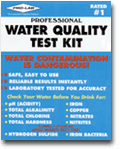
PROFESSIONAL WATER QUALITY TEST KIT The PRO-LAB Professional Water Quality
Test Kit contains eight (8) individually foil wrapped, laboratory
grade test strips (patented), allowing you to perform two (2) of
each test in order to determine the quality of your water. There
are also directions on this page, to check for two (2) additional
contaminants, iron bacteria and hydrogen sulfide. Each test has
its own directions. For accurate results, you much follow the directions
exactly. pH is a measure of the acidic or basic character of water. Results below 7 indicate acidity and above 7 indicates alkalinity. Water with low pH can be corrosive to plumbing fixtures, hot water systems, and leave red stains on galvanized pipe, blue-green stains on copper, and may also release harmful amounts of lead into your water from solder joints and pipes. Total Alkalinity is the ability of water to resist change in pH. A low total alkalinity may cause your water to appear cloudy and contribute to scaling. When the total alkalinity is too high the pH tends to be high as well. Total Chlorine Consists of both free chlorine and combined (already reacted)chlorine. Free chlorine affects the taste and odor of your water and may irritate your skin abd eyes. Chlorine is used to disinfect water in both private and Public Water Systems. However, during the disinfection process, excessive amounts of chlorine may react with decaying organic matter to form trihalomethanes, which can cause cancer. Total Hardness is a measure of calcium and magnesium in your water. Hard water over125 parts per million tends to form scales inside pipes creating a barrier between lead solder and the water itself thereby helping to preveent lead from entering into your drinking water. Low hardness, (soft water), less than 54 parts per million, can be corrosive to your plumbing. pH, Total Alkalinity, Total Chlorine, Total
Hardness Test Directions 2. Take one pH, Total Alkalinity, Total Chlorine, Total Hardness test strip and dip it in the water sample for five (5) seconds with constant, gentle back-and-forth motion. 3. Remove the test strip from the water sample and SHAKE ONCE to remove excess water. Wait an additional twenty (20) seconds and then match to closest color. Complete color matching within ten (10) seconds.
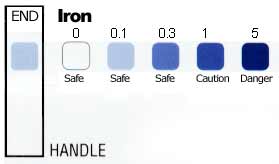
Iron is a mineral found in the ground, which can be in your drinking water. Iron is essential to good health, however iron levels about .3 parts per million can cause brown, orange, or yellow color stains to your plumbing fixtures and laundry. Iron Test Directions
Iron Bacteria is another form of iron that may be present in your water system. Iron bacteria is commonly found in toilet flush tanks as a brown, slimy residue. The test for iron bacteria does not require a test strip, to determine if you have a problem just follow the next two (2) steps:
Copper is a metal, which is commonly found in your drinking water. Small amounts are generally not a problem. However, copper levels above 1 part per million can cause jaundice, pancreatitis, poisoning of th ered blood cells, gastrointestinal problems and anemia. The presence of copper also affects water's taste and may stain your porcelain toilets and sinks. Copper Test Directions
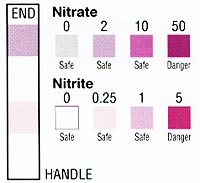
Nitrate / Nitrite Nitrogen is a chemical resulting from fertilizeer, sewage (humann waste), animal waste and other geological elements. Concentration over 10 parts per million for nitrates and 1 part per million for nitrites, can cause a condition know as :Blue Baby syndrome"; a poisoning of the blood which reduces the amount of oxygen available to infant children and also the fetus of pregnant women. It can be fatal. Nitrate / Nitrite TEst Directions
Hydrogen Sulfide is a gas, that can be detected by its rotten-egg odor. The test for Hydrogen Sulfide does not require a test strip, to determine if you have a problem just follow the next two (2) steps:
Results: If you smell the rotten-egg odor on both the hot and cold water, you probaby have a hydrogen sulfide problem, if the odor is only on either the hot or cold waer, and not both, then more than likely hydrogen sulfide is not a problem. |